
🎯
Local object detection
Run YOLO26s or D-FINE-S with ONNX Runtime on CPU or NVIDIA CUDA.
A self-hosted pipeline from live camera streams to annotated event clips, vision-language analysis, and natural-language search.

VSL (Video Search Local) is a self-hosted AI system for real-time camera understanding, event recording, and semantic video search. It ingests RTSP, RTMP, HLS, and other streams; detects and tracks people, vehicles, and other objects locally; records an annotated clip when a user-defined rule matches; asks a vision-language API to describe the event; and stores the result in SQLite and Qdrant.
Instead of reviewing hours of footage, users can search for descriptions such as “an elderly person walking past” or “vehicles in the parking lot” and replay the matching events.
The pipeline turns conventional footage into structured events with timestamps, objects, stable track IDs, trajectories, activities, risks, and natural-language summaries. Read How it works for the complete data flow.
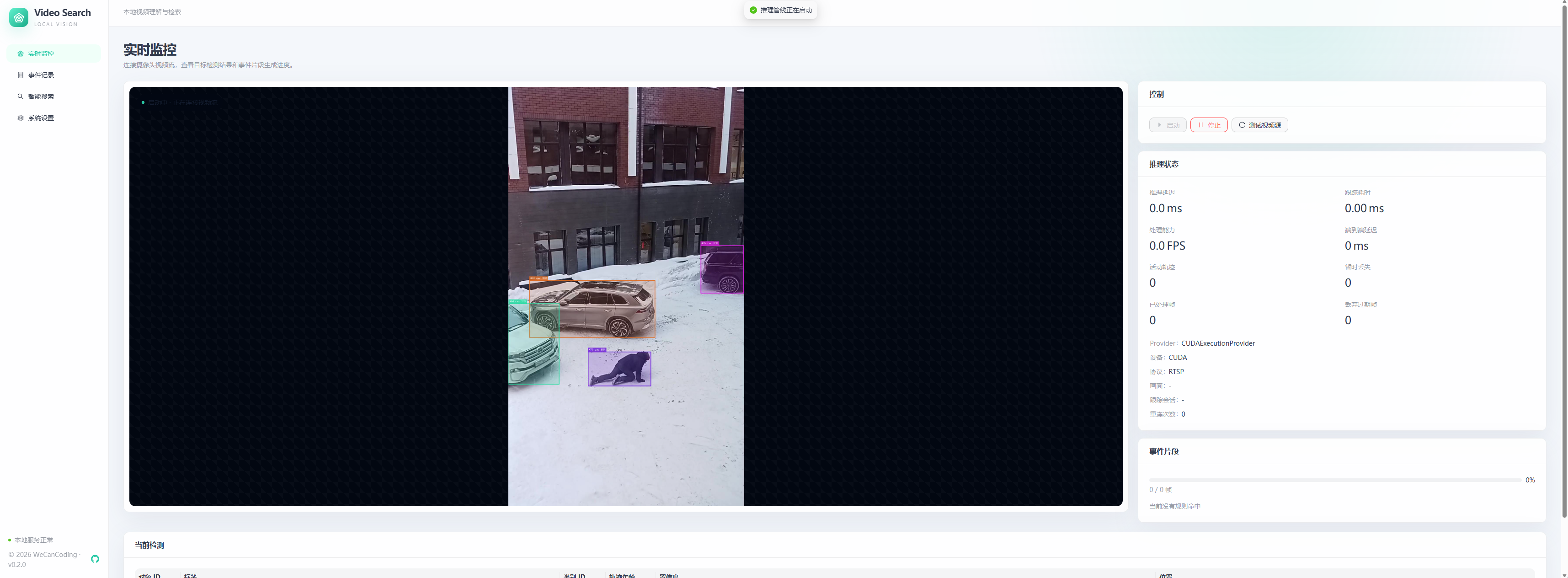
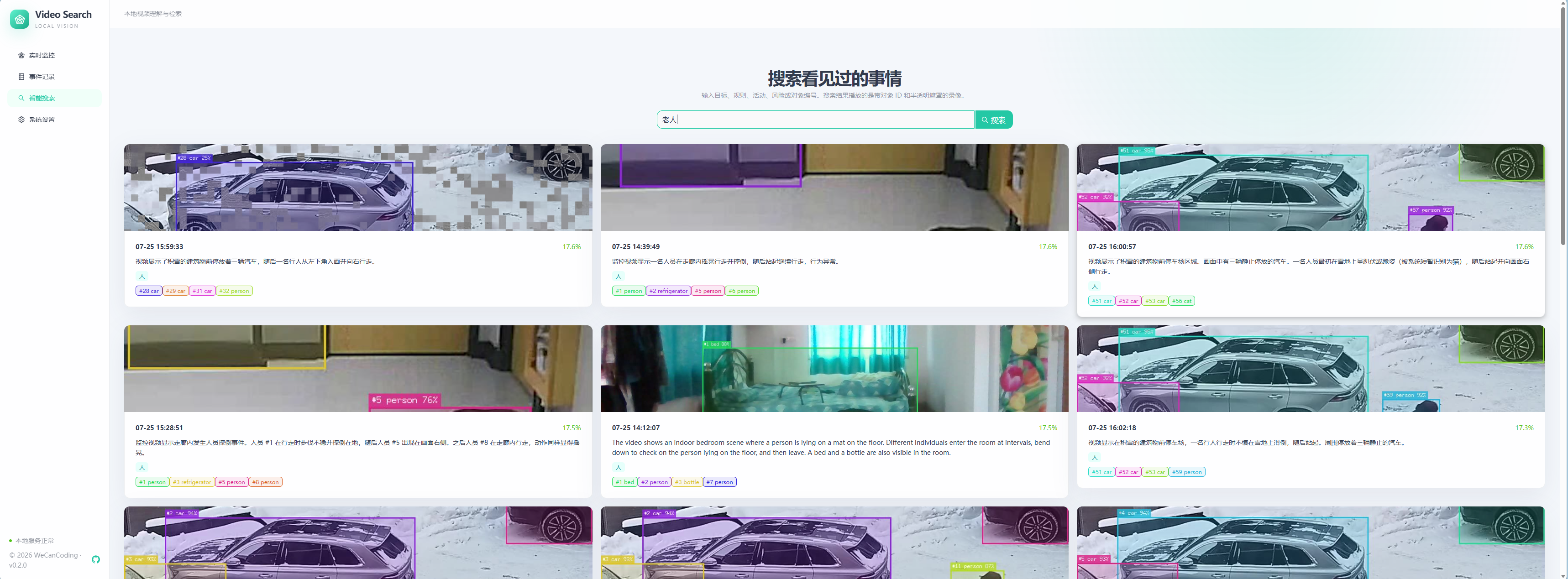
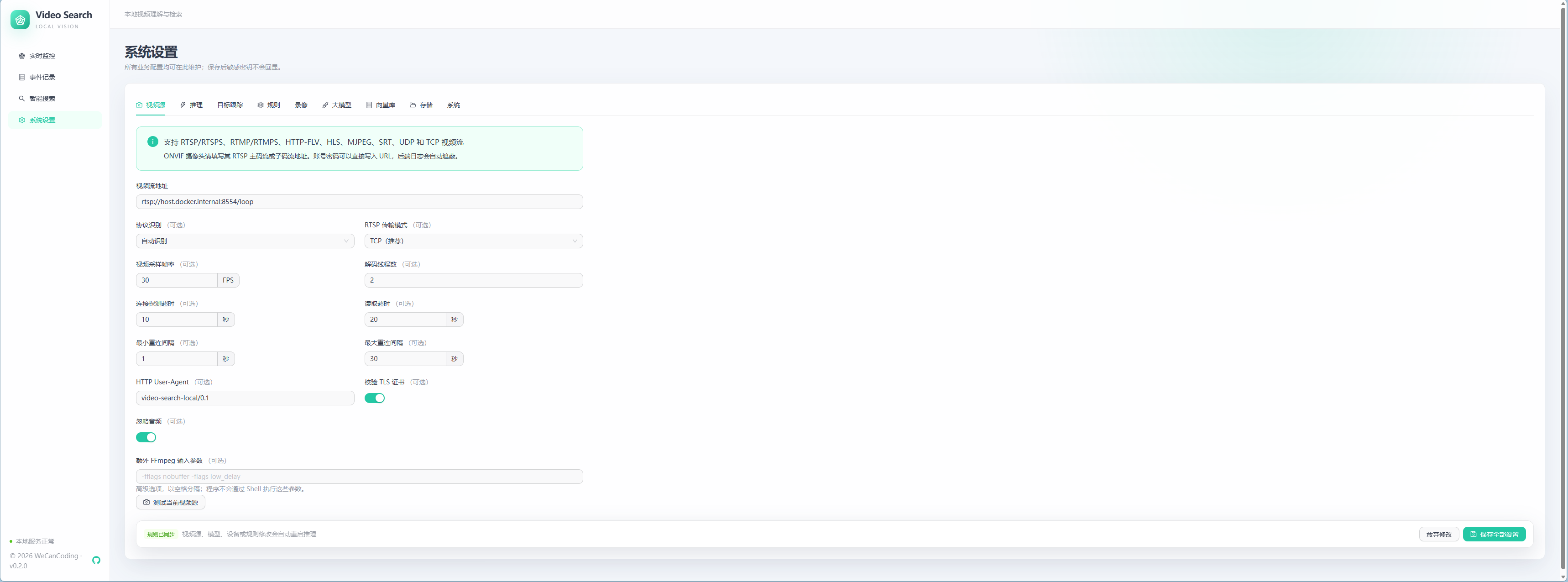
VSL currently supports common network streams, YOLO26s and D-FINE-S detection, ByteTrack, browser-based rules, annotated event recording, OpenAI-compatible vision APIs, DashScope native video analysis, a persistent SQLite job queue, and Qdrant retrieval. It runs on CPU or NVIDIA CUDA.
The current release is a single-stream, single-machine, single-user foundation. It does not include face recognition, cross-camera ReID, automatic ONVIF discovery, a GB28181 gateway, or audio analysis. See the FAQ for current boundaries.
No. CPU mode is suitable for evaluation and low frame rates. NVIDIA CUDA is recommended for sustained real-time analysis. The model, device, inference rate, and runtime threads are configurable in the browser.
No. Local models perform detection, tracking, and rule evaluation first. Only matched event clips are sent to the configured vision-language API, and an API failure never stops local inference.
Yes. Event clips, covers, and frames sent to the VLM can contain translucent colored masks, boxes, classes, confidence scores, and track IDs.
Yes. The source code is published under the GNU AGPL-3.0. You may inspect, modify, and self-host it subject to the license terms.
Read the quick start or visit the GitHub repository.